Fruit
| ||||||
 Artwork of various fruits from Animal Crossing: New Leaf. From left to right, top to bottom: apple, pear, peach, orange, durian, banana, cherry | ||||||
| Type | Food | |||||
|---|---|---|---|---|---|---|
| Spawns | Every three days on fruit-bearing trees | |||||
| Main appearances | ||||||
|
| ||||||
| Other appearances | ||||||
Fruits are food items in the Animal Crossing series. They can be buried to grow fruit-bearing trees. Each town or island starts with several fruit trees that bear one of five types of fruit—either apples, cherries, oranges, peaches, or pears—that is known as the native fruit and sells for 100 Bells each. The other four non-native fruits can be obtained later through other means and sell for 500 Bells each. Coconuts sell for 150 Bells in Animal Crossing, 500 Bells in Animal Crossing: Wild World and Animal Crossing: City Folk, and 250 Bells in Animal Crossing: New Leaf and Animal Crossing: New Horizons. Prior to New Horizons, eating a fruit has no effect except freeing up space in the player's pockets.
Appearances[edit]
In Animal Crossing[edit]
In Doubutsu no Mori, Doubutsu no Mori+, Animal Crossing, and Doubutsu no Mori e+, both native and non-native fruits can be obtained as gifts from villagers, and balloon presents have a 20% chance of containing a non-native fruit.
In Animal Crossing and Doubutsu no Mori e+ only, coconuts can be obtained from palm trees on Animal Island and planted in one of the F-acres in town.
In Wild World[edit]
In Animal Crossing: Wild World, both native and non-native fruits can be obtained from letters from villagers[nb 1] and Mom. Coconuts now wash up on the beach every few days.
In City Folk[edit]
In Animal Crossing: City Folk, non-native fruits can be obtained in two different ways. The most common way to acquire non-native fruit by traveling to a town where they grow and can mail fruit to players in other towns. The player can alternatively send a letter to a resident of their town with the contents saying "How are you?" with a fruit attached, native or not. A couple days later, a letter with a present attached will be received, containing either a fruit (native or non-native) or a shirt. The same thing works with sick neighbors, with "Get well soon!" being on the letter. Like in Wild World, coconuts wash up on the beach every few days.
Wendell designs[edit]
The following designs are given to the player by Wendell if he is given a fruit:
- Apple – Coloring Nook
- Cherry – Coloring Resetti
- Coconut – Coloring House
- Orange – Coloring Pelly
- Peach – Coloring Rover
- Pear – Coloring K.K.
In New Leaf[edit]
In Animal Crossing: New Leaf, all fruits can be stacked in the player's pockets up to nine. Villagers can now request the player to give them a specific fruit, and fruits can be given to Dr. Shrunk in exchange for one of his jokes. Additionally, the following six fruits are added, which all sell for 250 Bells:
 Banana – obtained from palm trees on Tortimer Island.
 Durian – obtained from trees on Tortimer Island.
 Lemon – obtained from trees on Tortimer Island.
 Lychee – obtained from trees on Tortimer Island.
 Mango – obtained from trees on Tortimer Island.
 Persimmon – obtained from the gardening corner at T&T Emporium for 1,000 Bells.


Coconuts are now obtained from palm trees on Tortimer Island.
The five fruits that can naturally grow in the player's town now have "perfect" variants, which sell for more (600 Bells if native, 3,000 Bells if non-native) and have a slightly different appearance. When a town is created, one of the fruits on a single fruit tree is a perfect variant; it can be planted to grow perfect fruit trees. Once a perfect fruit tree is harvested around four to seven times, its leaves fall off and one of its three fruits is a "rotten" variant, which acts as a trash item.
In New Horizons[edit]
In Animal Crossing: New Horizons, eating a fruit gives the player one energy point, allowing them to break rocks and dig up trees. The exotic fruits from New Leaf do not return; like in earlier games, only the five possible native fruits and the coconut appear in New Horizons. All fruits now stack to ten.
An island's native fruit can be purchased from Nook's Cranny for 400 Bells, and it is displayed on the player's passport. In addition to a native fruit, each island has a secondary fruit, which will appear on trees on certain Mystery Islands. Mystery Islands are also the source of coconuts.
Use in crafting and cooking[edit]
Fruits are used as crafting materials or cooking ingredients in the DIY recipes for the following items.
Recipes in Animal Crossing: New Horizons


 10×
10×  4×
4× 


 10×
10×  2×
2× 
 2×
2× 


 10×
10× 
 4×
4× 


 10×
10× 


 10×
10× 


 1×
1× 

 5×
5× 


 2×
2× 


 1×
1× 


In Pocket Camp[edit]
In Animal Crossing: Pocket Camp, the five standard fruits and coconuts are available from the start. Apples, cherries, oranges, peaches, and pears grow at Breezy Hollow and Lost Lure Creek, while coconuts grow at Saltwater Shores and Sunburst Island. Unlike in main series games, all of the aforementioned fruits sell for 10 Bells.
Beginning in version 2.1.0, one of three new fruits—lemons, lychees, or grapes—grow at Breezy Hollow and Lost Lure Creek, similar to native fruits from the main series games. The two fruits that are not native can only be obtained from other players' market boxes and cannot be planted. Non-native fruits sell for 600 Bells.
Perfect fruits return from New Leaf, now having a 2.38% chance of growing on any non-Coconut fruit tree. Native perfect fruits sell for 600 Bells, while non-native ones sell for 1,200 Bells.
Fruit is used to complete requests for villagers. Villagers will ask specifically for the five standard fruits, coconuts, and the player's native fruit, while any fruit may be used for requests in which the villager asks the player to pick what to give.
Since version 5.4.0 the game's app icon also features a banana icon, but bananas have not been added to the game yet.
Other appearances[edit]
In the Super Smash Bros. series[edit]
In Super Smash Bros. for Nintendo 3DS / Wii U[edit]
In Super Smash Bros. for Nintendo 3DS / Wii U, fruits appear on Tortimer Island, where they can be knocked from the trees and used to restore health. They are also thrown by Isabelle when she appears as an Assist Trophy.
In Super Smash Bros. Ultimate[edit]
Fruits reappear on Tortimer Island in Super Smash Bros. Ultimate.
List of fruits[edit]
| Fruits in the Animal Crossing series | |||||||||||
|---|---|---|---|---|---|---|---|---|---|---|---|
| Fruit | Game | ||||||||||
| Doubutsu no Mori | Animal Crossing | Wild World | City Folk | New Leaf | Pocket Camp | New Horizons | |||||
| Apple | 
|
 |
|
|
|
|
|
| |||
| Banana |
|
 |
|
|
|
|
|
| |||
| Cherry | 
|
|
|
|
|
|
|
| |||
| Coconut | 
|
|
|
|
|
|
|
| |||
| Durian |
|
|
|
|
|
|
|
| |||
| Grapes | 
|
|
|
|
|
|
|
| |||
| Lemon | 
|
|
|
|
|
|
|
| |||
| Lychee | 
|
|
|
|
|
|
|
| |||
| Mango |
|
|
|
|
|
|
|
| |||
| Orange | 
|
|
|
|
|
|
|
| |||
| Peach | 
|
|
|
|
|
|
|
| |||
| Pear | 
|
|
|
|
|
|
|
| |||
| Persimmon |
|
|
|
|
|
|
|
| |||
Gallery[edit]

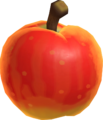
Apple
(New Horizons)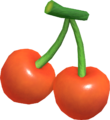
Cherry
(New Horizons)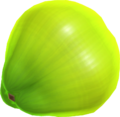
Coconut
(New Horizons)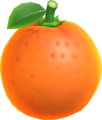
Orange
(New Horizons)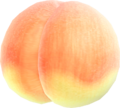
Peach
(New Horizons)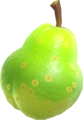
Pear
(New Horizons)
_NH.png)
_NH.png)


Notes[edit]
- ↑ Only if the player sent them a letter that contained an attached item and was graded internally as low-quality.

Further details: Needs screenshots
Further details: Needs screenshots
| Flora | ||||||||||||||||
|---|---|---|---|---|---|---|---|---|---|---|---|---|---|---|---|---|
| ||||||||||||||||